Hiring the right people is one of the most important — and most time-consuming — things your business does. If your internal team is stretched thin, your time-to-fill is creeping up, or you’re facing a high-volume hiring push you simply aren’t staffed to manage, recruitment process outsourcing (RPO) might be exactly the solution you’ve been looking for. South Carolina employers, especially those growing rapidly in the Charleston metro and surrounding Lowcountry, are turning to RPO services to take the burden off their HR teams without sacrificing control over who joins their company.
What Is Recruitment Process Outsourcing and How Does It Work?
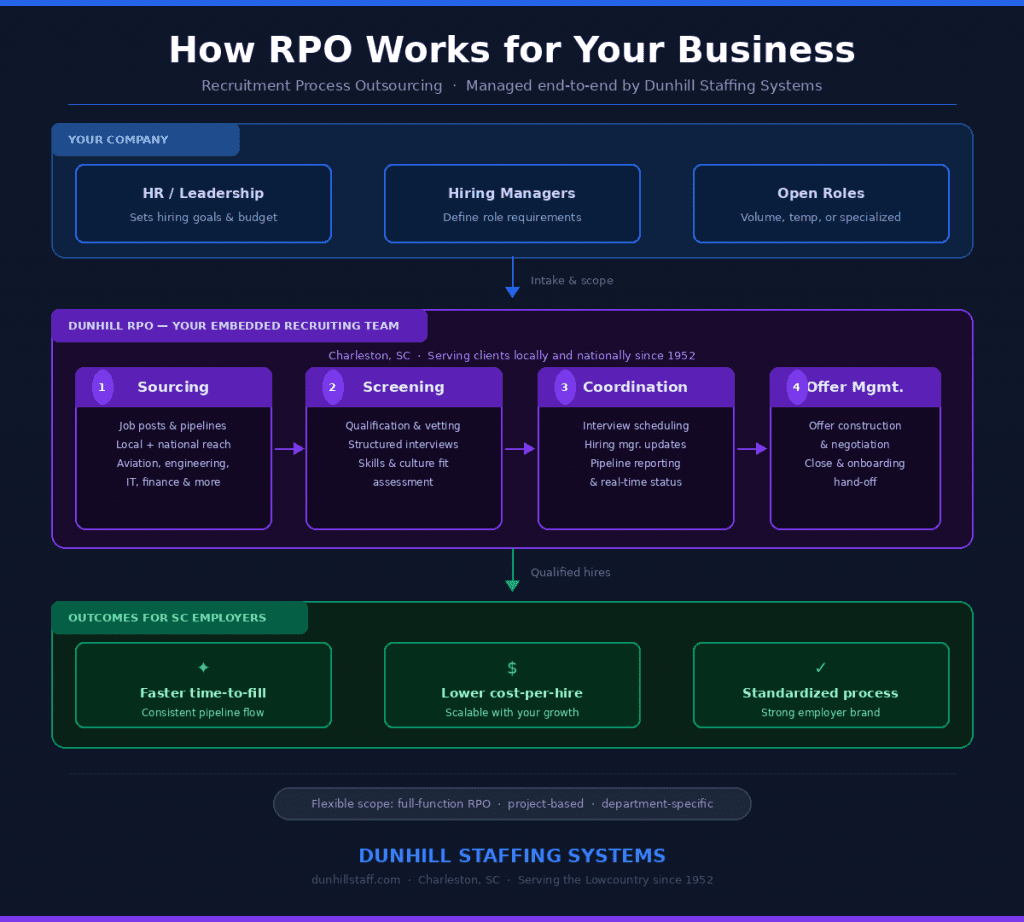
RPO is a model where a company transfers all or part of its recruitment function to an external provider. Unlike traditional staffing — where an agency fills a single role and hands you a candidate — RPO is a deeper, ongoing partnership. The provider acts as an extension of your HR team, managing everything from job postings and sourcing to screening, interviewing coordination, and offer management.
The scope can be tailored to what you actually need. Some employers outsource their entire talent acquisition function. Others bring in an RPO partner for a specific department, a surge hiring period, or a single project — like standing up a new facility or scaling a team after a major contract win. That flexibility is exactly what makes it appealing for growing companies across industries, from manufacturing in Berkeley County to tech firms in Charleston’s Upper Peninsula.
Dunhill’s RPO services are built around that kind of flexibility — designed to meet your business where it is, not lock you into a one-size-fits-all contract.
How RPO Services Help Charleston Employers Hire Smarter
The pressure on hiring managers in the Lowcountry is real. Companies like Boeing’s 787 Dreamliner facility in North Charleston, Volvo Cars in Berkeley County, and the growing network of suppliers and service firms that support them all compete for the same finite pool of qualified candidates. When your process is slow or inconsistent, you lose talent to faster-moving competitors — sometimes before you ever get to the offer stage.
RPO addresses this by bringing dedicated recruiting infrastructure to your organization. That means consistent sourcing strategies, faster turnaround on screenings, structured interview processes, and real-time reporting on where your pipeline stands. Instead of relying on an overloaded HR generalist or posting jobs and hoping, you have a team whose only job is filling your roles — efficiently and to spec.
There are real cost advantages, too. Agencies that operate RPO programs typically offer a per-hire or monthly retainer model that costs significantly less than building out internal recruiting capacity or paying individual placement fees across dozens of hires. For companies going through rapid growth — especially along the I-26 corridor in Summerville, Nexton, and Cane Bay — that scalability can be a genuine competitive advantage.
Is RPO the Right Fit for Your Business?
RPO works best in specific situations. If you’re hiring 10 or more people per year, dealing with high turnover in certain roles, launching a new location, or entering a market you haven’t hired in before, RPO is worth a serious conversation. It also makes a lot of sense for mid-sized companies that are too large to survive on reactive hiring but not large enough to justify a full internal talent acquisition team.
It’s also worth considering if consistency is a problem. One of the quieter benefits of RPO is that it standardizes your hiring process. Every candidate goes through the same experience, every hiring manager gets the same quality of intake and communication, and every new hire is brought in through a process that’s been designed — not improvised. For companies that want to build a strong employer brand in the Charleston market, that consistency matters more than most people realize.
That said, RPO isn’t the answer for every situation. If you’re filling one or two specialized roles per year, traditional executive search or direct placement may be a better fit. A good RPO partner will tell you honestly which model makes sense for your volume and needs.
What to Look for in an RPO Partner in South Carolina
Not all RPO providers are created equal. National firms often bring scale but lack the local market knowledge that makes a real difference when you’re trying to understand why candidates are dropping out mid-process — or why a competitive salary in one zip code falls short in another. Knowing that a candidate in Goose Creek weighs the Ravenel Bridge commute differently than someone already working in North Charleston isn’t a small thing. It affects sourcing strategy, offer construction, and ultimately, whether a hire sticks.
Local expertise matters. So does specialization. If your workforce needs lean heavily on engineering, technical talent, or roles tied to aerospace and manufacturing — as many South Carolina employers do — you want an RPO partner who already has pipelines in those disciplines, not one learning your industry as they go.
Dunhill has served the Lowcountry since 1952 and has been named Charleston’s favorite staffing company multiple years running. That history means established relationships, deep local networks, and an understanding of this market’s rhythms that no national firm can replicate.
Ready to Take Recruiting Off Your Plate?
If your team is spending more time chasing candidates than growing your business, it’s worth exploring what the right outsourced recruiting solution could do for you. Dunhill’s RPO services are designed for South Carolina employers who need a smarter, more scalable approach to hiring — whether that’s managing your full recruitment function or supporting a specific department through a period of growth.
Let’s talk about what your hiring actually needs. Contact a Dunhill recruiter today to start the conversation, or learn more about how our RPO services can be customized for your business.